Spiral reinforcement is one of the most important and critical components of building foundations, even though it is usually hidden from view once the concrete pour is complete. Its primary role is to give the pile reinforcement cage strength, stability, and long-term durability, especially under extreme loads and in complex ground conditions.
A spiral is a steel bar—usually deformed rebar—wound continuously around the pile’s longitudinal reinforcement bars. Unlike individual ties, the continuous spiral forms a strong, uniform confinement layer that helps the concrete and reinforcement work together efficiently.
One of the main functions of spiral reinforcement is to confine the concrete core and prevent it from expanding laterally under high vertical loads. This significantly increases the pile’s load-bearing and compressive capacity and improves its long-term durability. The spiral also strengthens the pile against shear forces and ground movement by helping prevent diagonal cracks caused by horizontal pressure or ground settlement.
Another important function is to hold the longitudinal reinforcing bars in position. Under heavy loads, the bars may buckle or move outward; the spiral prevents this by providing continuous, stable circumferential restraint.
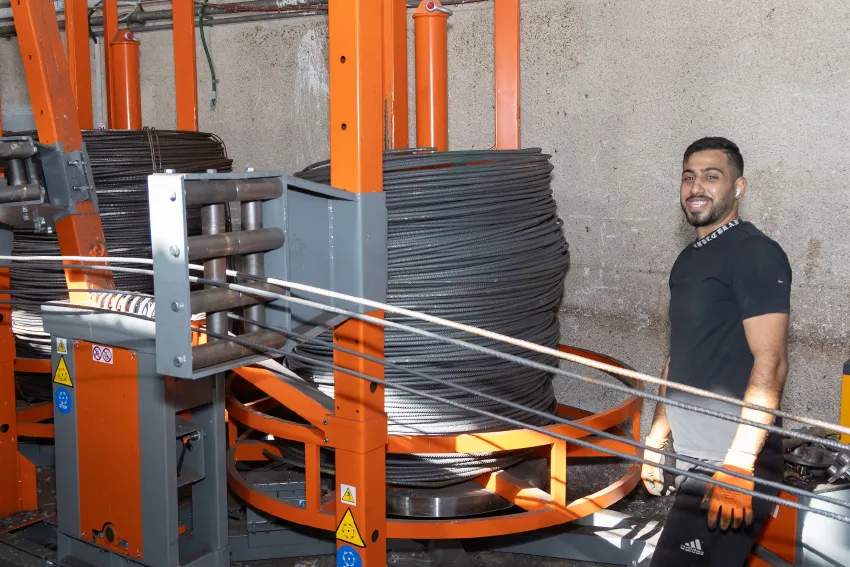
High-quality spiral reinforcement is now produced on automated machinery that ensures precise geometry and a uniform pitch along the entire element. The spacing between turns—known as the pitch—is specified by the structural engineer according to the project requirements, soil type, and anticipated loads. The less stable the soil or the greater the structural loads, the tighter the pitch required to provide more substantial reinforcement.
It is also essential to select the appropriate steel diameter and execute precise overlaps at the ends of the spiral to ensure full structural continuity throughout the entire drilling depth.
Ultimately, although this component is no longer visible once the work is complete, spiral reinforcement for pile cages plays a critical role in the safety, stability, and durability of the entire structure. It is an integral part of the engineering foundation supporting every high-quality, professional construction project.